The Land
Our upland smallholding lies just outside Moffat, shaped by weather, water, wildlife and our sometimes haphazard attempts to make things grow.
How it began
We arrived on Lammas Eve 1992. We’d bought a two-up, two-down whinstone shepherd’s cottage, surrounded by grass and one tree. And a little ramshackle outbuilding, already falling apart, with a young elder growing from it.
We thought we’d decluttered, but not enough. For months, the cottage was mostly a series of narrow paths between cardboard boxes—not least because we got side tracked by replanting things brought from our previous garden and trying out the good life for size. I remember the taste of my first home-grown kohlrabi. And the Invicta gooseberry we brought from Manchester is still here and thriving.
Fifteen months after we moved in, the cottage burned down. Rebuilding took an age. Meanwhile we lived in caravans on site and fenced off a patch at the back to grow vegetables. I particularly remember the rows of strawberries and peas – our older son and daughter used to escape through the caravan window at dusk to eat them straight from the plants. Their stage whispers and giggles gave them away.
Planting trees, finding a forest
Over the first few years, we planted more than 4,000 trees, long stretches of hedging and fenced off two wetland areas. Our intention was to create shelter and wildlife habitat across land that had been pasture for generations.
Then work, family life and other stuff took over as it often does, and much of the land was left to get on with things. It turned out that this was not the same as nothing happening.
When grazing ended early in one field, we discovered 147 self-seeded oaks, planted by jays. Yellow rattle began weakening the grass elsewhere, making room for orchids and other meadow flowers. Oaks and rowans started edging down the slope from the fragment of temperate rainforest woodland at the bottom of the holding.
The land was beginning to show us what it could do when we got out of the way.
At the edge of a rainforest
At the bottom of the holding is a fragment of temperate rainforest woodland, part of the oak woods that run along the western side of the valley. I remain completely enchanted by the fact that this is where we live.
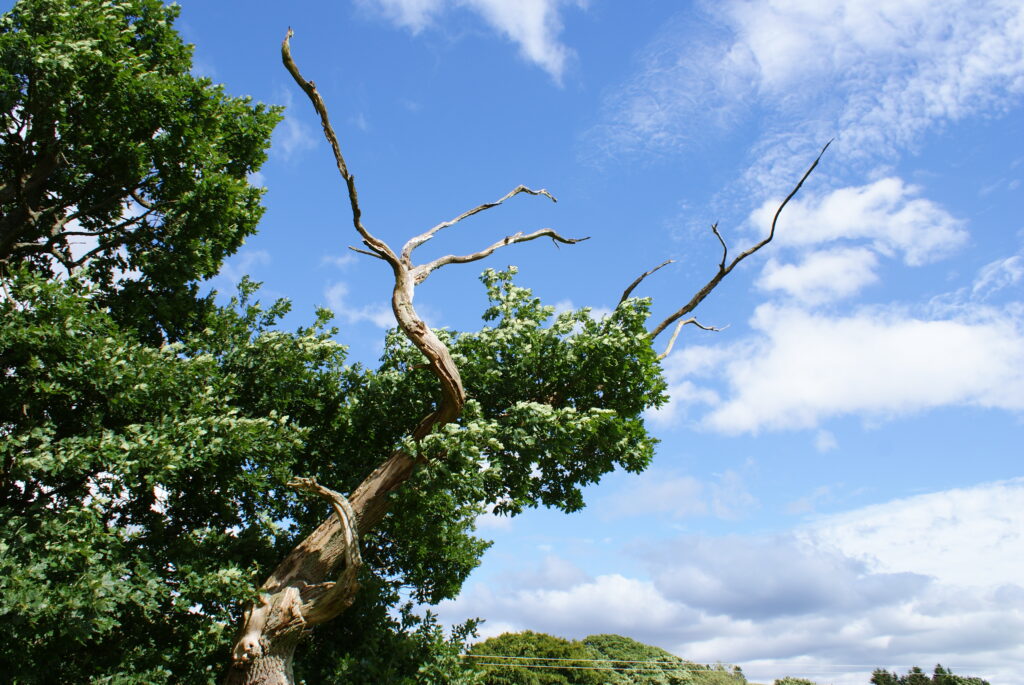
One of its elders is a magnificent, ancient staghorn oak, which we named Merlin, overlooking the Moffat Hills. The Ancient Tree Hunt estimated that he could be as much as 700 years old. He is hollowing out now and sometimes sheds branches, but wild raspberries and rowans have taken root in the crook of his lower branches.
Like all of life, he is slowly becoming a habitat made from his own decay—a wonderful lesson in how beautifully a woodland can grow old.
Restoring the meadow
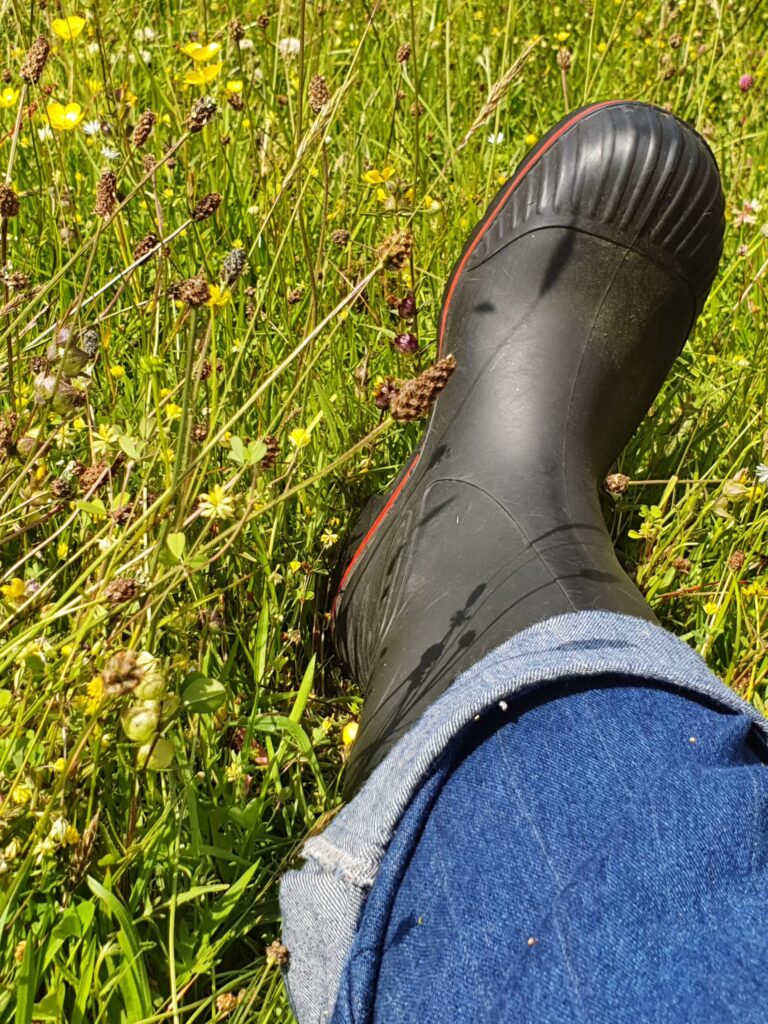
Yellow rattle did its work here for many years, weakening the grass and allowing a naturally regenerating meadow to emerge. But this is wet land, and over time docks and more vigorous grasses began taking hold again.
We are now working with Buglife to restore and reseed part of the meadow. The work is happening in early autumn 2026, after two difficult years for native wildflower seed production, when seed has often been in short supply. We’ll record what happens next—not just the flowers that appear, but the insects and other lives that arrive with them.
Along Annan Water
Two areas close to Annan Water have been planted over two consecutive years recently, funded by D&G Woodlands, with the planting carried out by TreeSurv.
Some trees in the first area are already around ten feet high. The aspens are doing particularly well and should eventually bring a wonderful wash of yellow to the riverbank in autumn. Aspen spreads by sending up suckers from its roots, so what looks like a whole gathering of trees may be one connected plant.
The wolf fence
Technically, it is deer fencing. But I once came across the term “wolf fence” for a protected area in the Highlands, and it seemed both more graphic and more truthful. The fence is doing work once done by wolves, before we hunted them to extinction: changing where and how deer can graze.
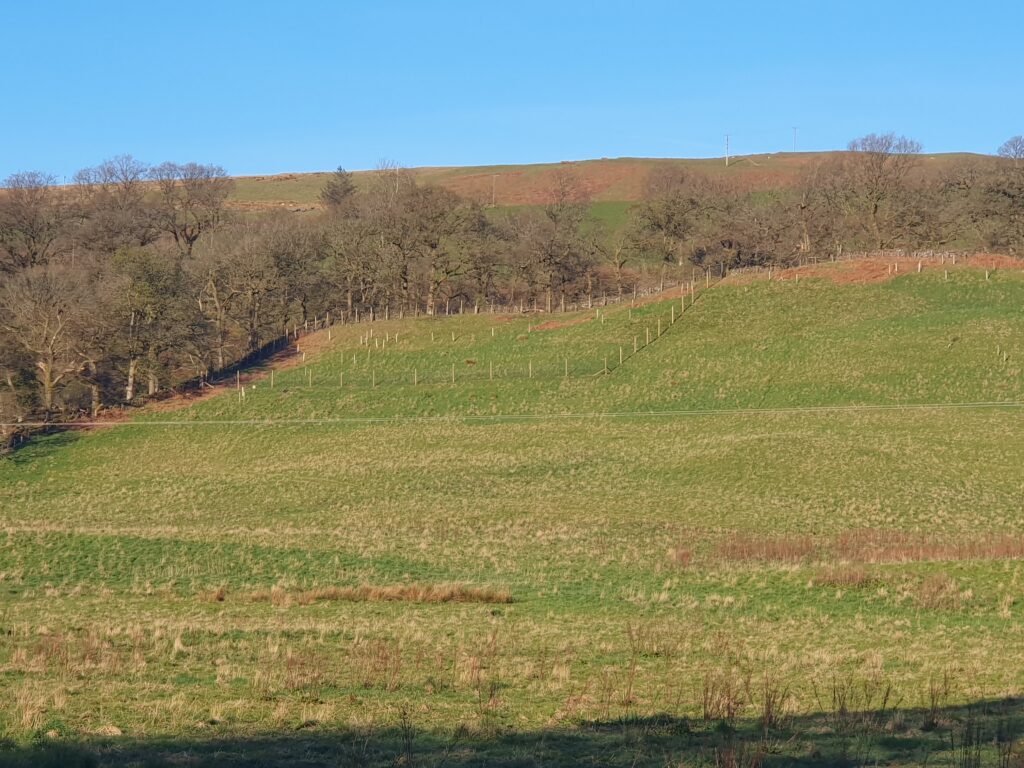
Our younger son, who is a forester, noticed natural regeneration of oak and rowan on the upper slopes beside the ancient oak woodland. He protected individual trees over the years, but much of the new growth was still being browsed by deer.
Now, with funding from D&G Woodlands and work by TreeSurv, a large block at the top of the slope has been enclosed. We are already seeing extraordinary regeneration in the understorey. It is a fantastic experiment in what returns when grazing pressure is lifted and the land is given the chance to respond.